
“What are you giving up for Lent?” While the question alludes to historic Christian practices of fasting and self-denial associated with the penitential season of Lent, the syntax of the question also points out a crucial shift: even our self-denial is an act of self-expression. Our submission to discipline is converted to act of will power.
— James K. A. Smith, An American Lent
Dear Lectio Letter Readers,
I’m sending this to reassure you that I still live! Apologies for the delay in getting something out to you. The good news is that I have been very busy with the very thing that this newsletter was started to support which is creating Spiritual Formation and Theology curriculum for people engaged in cross cultural mission environments. So of course, I want to thank you very much for continuing to back me despite the embracing irregularity of these emails, I am still very much committed to offering you the overflow of my research and reading.
In addition I have 2 perks I’m releasing for supporting members of the newsletter! The first is a full searchable index of all the recipes I’ve ever posted on the lectio letter. The second is that, as a paid subscriber you can ask an anonymous question about theology / discipleship and I promise to write at least 500 words answering it in an upcoming lectio letter! Scroll to the bottom of the email to find out how.
If you happen to be new here, there’s a whole 101 other issues you can explore here! And I’d be over the moon if you’d consider supporting our work in deepening discipleship for those engaged in cross cultural ministry. You can become a paying subscriber by using the button below or read more about our work here.
A Different Format?

For a little while, I’ve been suspecting the regular format of the Lectio maybe not be sustainable. Both editing an article, collecting miscellany, sharing life updates, music and recipes. I can do a few of those at once, but getting them altogether is simply taking too long. The likelihood is that I may post more regularly but only do 1 or 2 of the things I’ve normally included in all the newsletters at a time. We’ll see how that goes.
For now, I’ve got about 3 unfinished articles that I hope to polish up slightly more before they are sent out, but not wanting to leave you without a Lectio much longer I thought I’d experiment by sending out a collection of a few shorter unpolished thoughts that have arisen over the last month of work or so..
The Weight of Lent

I was having a conversation recently with someone who, while describing how busy they were with many good things, lamented that they hadn’t had time to prepare for Lent—and were now stuck in a vague, background hum of guilt about it.
A few years ago, I experienced a revival of enthusiasm for the Church Calendar. I’ve come to believe that, just as our individual, one-time retellings of the Gospel are important, the Christian Calendar, repeating the story of salvation year after year, shapes our lives by immersing us in the Gospel again and again.
But what is most significant about the Christian Calendar is not that I, individually, choose to rehearse the story of the Gospel, but that I enter into the Church’s rhythm of remembering the Story.
There are seasons when I have the capacity to engage with intention, and others when I don’t. The formative power of the Calendar is not that it sets up another threshold of individual achievement, a kind of A.P. class for discipleship. Its power is that you do not choose the timing, and the world does not dictate the seasons, the Church has chosen, and you are joined to something beyond yourself.
The good news is that, in the seasons when you cannot give your full effort to a liturgical season, you are still part of a countless multitude, alive now, stretching back through history and forward to Christ’s return, an army with banners, whose Lord, the Lamb, carries your life among theirs, remembering that Christ has come, Christ has risen, and Christ will come again. Liturgical seasons are not about performance anxiety; they are about letting your life, your story, be baptised and lifted up in the Story of God’s People, to be saved, not by your might or power, but by His great love.
Me and My Jesus; The evolution of Faith from Public Power to Personal Privilege

At the end of last year, in the midst of an unusually stressful week, I recorded a series of podcast episodes with Matt Lewis of “We are Follower”. In this first one he asked me to share how throughout history faith has retreated to ‘personal choice’ from the very structure that upheld our western world. I hope you enjoy it and stay subscribed to his podcast where I’ll share on a few different but connected topics for the next 2 or 3 episodes after this one.
In this episode, we explore how Western Christianity has shifted from a belief system deeply embedded in societal and political structures to one that is increasingly privatised and fragile.
Drawing on the insights of philosopher Charles Taylor, we examine the historical revolutions that have shaped our current secular landscape and how these changes impact Christian witness today. Join Matthew Lewis and Liam Byrnes as they walk carefully through these profound cultural transformations, seeking biblical truth in an age of confusion.
Key Topics:
• The historical development of secularism from the Reformation to today
• How the church’s relationship with power and influence has shifted over centuries
• The impact of individualism, privatisation, and the marketplace of ideas on faith
• The decline of a shared public faith and the rise of faith as a personal choice
• The role of fear, pain, and cultural shifts in shaping modern belief environments
• How Christians can embody winsome love and faithful presence amidst secular fragility
Some New Books I’m excited about
I suppose it wouldn’t be fair to only ask you to support me to buy books without telling you which one’s I’m excited about. Well here goes;
Pauline Theology as a Way of Life: A Vision of Human Flourishing in Christ – by Joshua W. Jipp

This book was recommended to me by Lucy Peppiatt on a recent call where she said that if she was teaching a course on the theological foundations of Spiritual Formation this would be the book she would use. Although I haven’t read it in detail, from paging through it I can see why.
In recent years there has been a shift in how popular theologians explain what Jesus accomplished that more clearly connects the beginning of the bible to the end. While many have participated in this, the lineage is in many ways as simple as NT Wright’s consistent insistence that the summary of the gospel is no less but much more than Jesus’ saving us from our sin. The arc of the story is, yes to save us from our sin, but also to recover what was lost and broken. God had an intention to partner with humans for their flourishing and his glory in Eden and this is how Jesus is the second Adam and the firstborn of the new creation.
Jipp in this book aims at unpacking Paul’s writings to reveal how Paul was actually seeing Jesus as that redemption, the one through whom we learn what it means to be truly and fully human as God intended. Rather than anachronistically approach Paul as a systematic theologian concerned only with justification or salvation in a narrow sense, Jipp presents Paul as offering a robust account of the transformed life; one shaped by union with Christ, empowered by the Spirit, and oriented toward embodied holiness as a loving community.
Jipp contends that Paul’s letters aim to form communities into a distinctive way of life. For Paul our relational knowledge of Jesus reshapes desires, habits, relationships, and social practices. In short, unlike in our modern world, belief and behavior are inseparable.
Where Prayer Becomes Real: How Honesty with God Transforms Your Soul – by Kyle Strobel and John Coe

Where Prayer Becomes Real is part of a popular level series that Strobel and Coe, who have been colleagues at the Institute for Spiritual Formation at Talbot, have been releasing.
This book, with depth and simplicity unpacks what prayer is and what it isn’t. Primarily the call is to move beyond distraction, performance, and guilt into a prayer life marked by authenticity and intimacy with God. This is the core message of the book, that getting stuck in prayer as performance is the very thing that keeps people from a rich prayer life.
If the Psalms are the church’s prayer book then the invitation is honesty and authenticity. That only when we bring the themes we think are most ‘out of bounds’ in prayer will we discover a God who is sees all of us, and is offering relationship and the transformative power of His presence.
In the Name of Jesus: Reflections on Christian Leadership – by Henri J. M. Nouwen
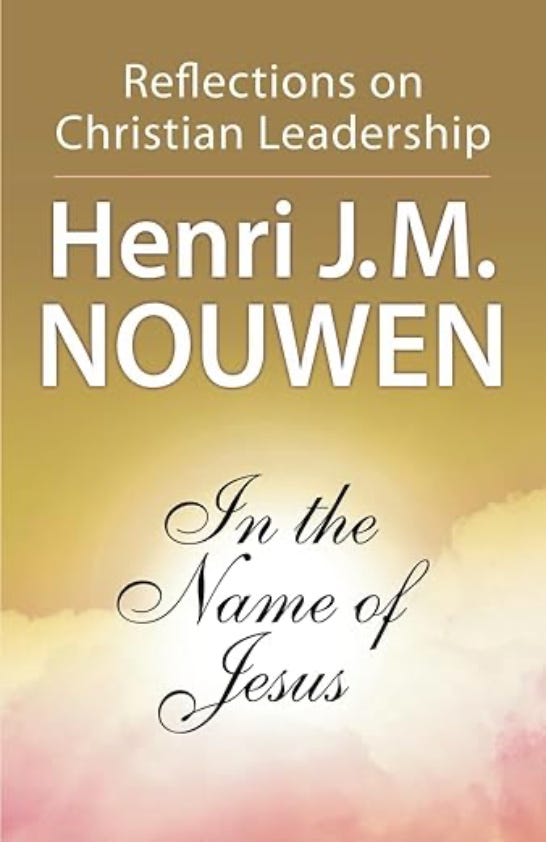
Although this book was written almost 40 years, it would be hard to think of a book more relevant to the current crisis in Christian Leadership. Henri Nouwen as a Dutch Catholic Priest transitioned from the competitive heights of academia into chaplaincy in a L’Arche communities for intellectually disabled adults. Nouwen is a master at pointing out the temptations of ego that follow Christian life and leadership and how simple humble other-oriented loving leadership is key. To remain “unimpressive” or “irrelevant” may in fact allow us to set aside concern of what others think of us in order to be truly service oriented to others.
